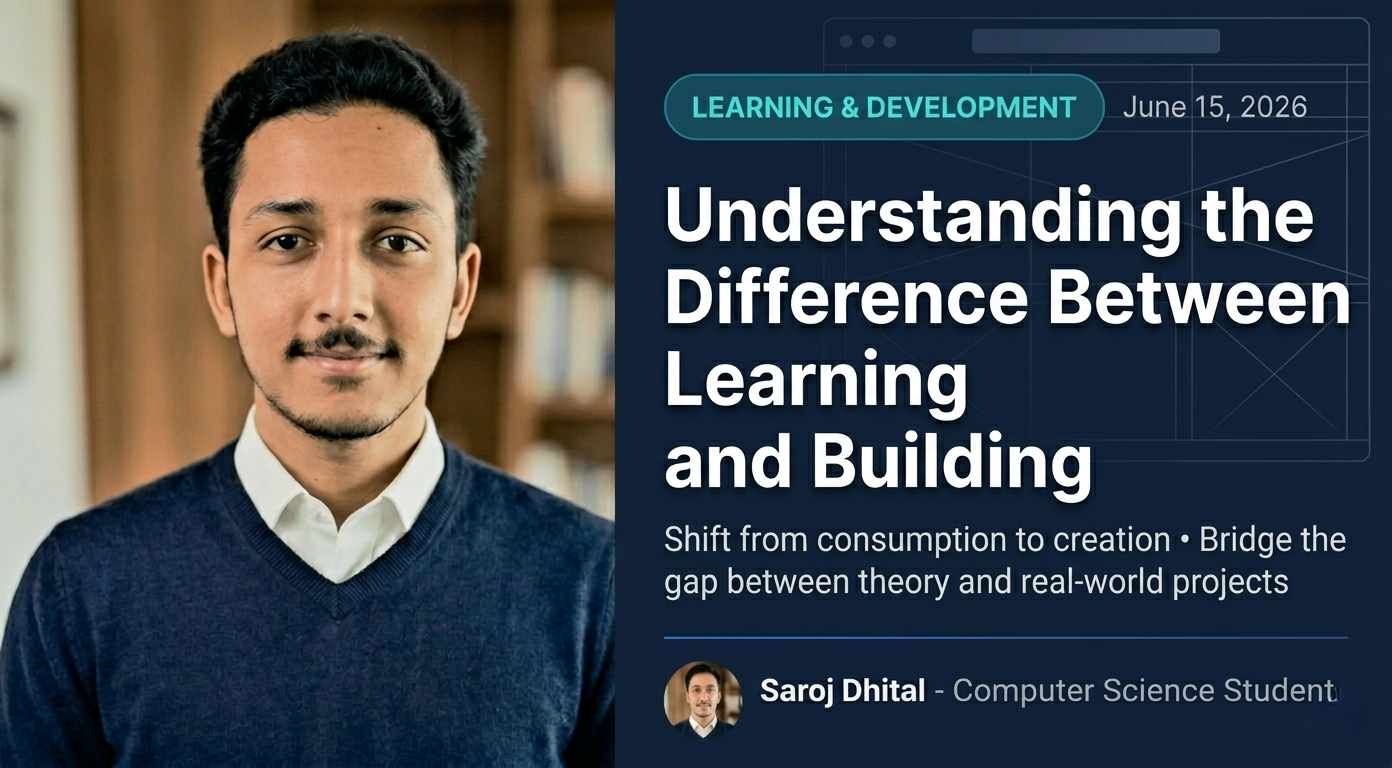

One of the most common challenges faced by IT students and aspiring developers is believing that learning automatically leads to building. While learning is an essential part of growth, it is only one side of the journey. The real transformation happens when knowledge is applied to create something meaningful.
Many students spend months watching tutorials, completing courses, and reading documentation. They feel productive because they are constantly consuming information. However, when asked to build a project from scratch, they often struggle to know where to begin.
The gap between learning and building is where true development takes place. Understanding this difference can dramatically change the way you approach your education and career.
Learning Feels Comfortable
Learning usually follows a structured path. Tutorials guide you step by step, instructors explain concepts clearly, and examples are often prepared in advance. This environment makes progress feel predictable and safe.
When following a course, you know exactly what comes next. The instructor has already solved the difficult problems and organized the content into manageable lessons. As a result, you rarely encounter the uncertainty that exists in real-world development.
There is nothing wrong with learning through courses and tutorials. They provide valuable foundations. The problem begins when learning becomes a substitute for building instead of preparation for it.
Building Feels Uncomfortable
Building is different. There is no instructor telling you exactly what to do next. You have to make decisions, research solutions, solve unexpected problems, and connect multiple concepts together.
This uncertainty can feel frustrating at first. You may encounter errors you have never seen before. Features may not work as expected. You might spend hours debugging a problem that seemed simple.
Yet these moments are where the deepest learning happens. Every obstacle forces you to think critically, investigate solutions, and develop confidence in your problem-solving abilities.
The Tutorial Trap
Many students unknowingly fall into what is often called the tutorial trap. They continuously start new courses because it feels like progress. Each completed tutorial creates a sense of achievement.
However, completing ten tutorials does not necessarily mean you can build ten applications independently. The moment you step outside the guided environment, the lack of practical experience becomes visible.
Tutorials should be viewed as training wheels, not permanent modes of learning. Their purpose is to prepare you for creating your own solutions, not to become your only source of experience.
Why Building Creates Real Understanding
It is possible to watch a tutorial on authentication, databases, APIs, or responsive design and feel like you understand the concepts. Building reveals whether that understanding is actually practical.
When creating a project yourself, you must decide how components are structured, how data flows through the application, how users interact with features, and how different technologies work together.
This process transforms theoretical knowledge into practical experience. Instead of remembering information temporarily, you begin understanding why certain approaches work and when they should be applied.
Learning and Building Should Work Together
Learning and building are not opposing activities. The strongest developers combine both consistently.
A healthy approach is to learn a concept and then immediately apply it through a small project. This reinforces understanding and exposes knowledge gaps much earlier.
For example, after learning about APIs, build a weather application. After studying databases, create a simple inventory system. After learning authentication, implement a login system in a personal project.
The faster you move from theory to implementation, the stronger your understanding becomes.
Projects Teach Lessons Courses Cannot
Real projects introduce challenges that rarely appear inside educational content. You learn how to organize files, structure code, manage time, handle bugs, improve performance, and make technical decisions independently.
You also learn how to deal with incomplete information. In real development, documentation may be unclear, requirements may change, and solutions may require experimentation.
These experiences are difficult to simulate inside a traditional course but become common when building actual applications.
Building Creates Confidence
Confidence in technology does not come from memorizing syntax. It comes from solving problems repeatedly.
Every completed project becomes evidence that you can take an idea, plan a solution, overcome obstacles, and deliver a working result.
Over time, this confidence makes it easier to learn new frameworks, languages, and tools because you trust your ability to figure things out.
The most successful developers are not the ones who know everything. They are the ones who know how to learn, adapt, and build despite not having all the answers immediately.
Signs You Need More Building and Less Learning
Sometimes it can be difficult to know whether you should continue studying or start building. A few signs often indicate that it is time to shift your focus.
- You keep starting new courses but rarely finish personal projects.
- You understand concepts in tutorials but struggle to implement them independently.
- Your portfolio contains more certificates than completed projects.
- You feel productive every day but have very little practical work to showcase.
- You frequently wait until you feel "ready" before starting a project.
If these situations sound familiar, building more projects may be the fastest path toward growth.
Finding the Right Balance
The goal is not to stop learning. Technology evolves constantly, and continuous learning will always be necessary. The goal is to create a balance where learning supports building and building reinforces learning.
A useful approach is to spend less time searching for the perfect course and more time creating projects, experimenting with ideas, and solving real problems.
Even small projects can teach lessons that hours of passive learning cannot provide.
Final Thoughts
Learning gives you knowledge. Building turns that knowledge into capability.
Courses, tutorials, books, and documentation are valuable tools, but they are only the beginning of the journey. Real growth happens when you step outside guided environments and start creating things on your own.
If you want to become a stronger developer, do not wait until you feel completely prepared. Start building with the knowledge you have today. The experience you gain along the way will teach you far more than another tutorial ever could.